Electric car market 2026: one in four new cars sold worldwide is electric
9.4 million electric vehicles sold in six months, over half of the Chinese market, record sales for BYD: the latest figures show a fast but very uneven electric transition across the world. Analysis country by country.
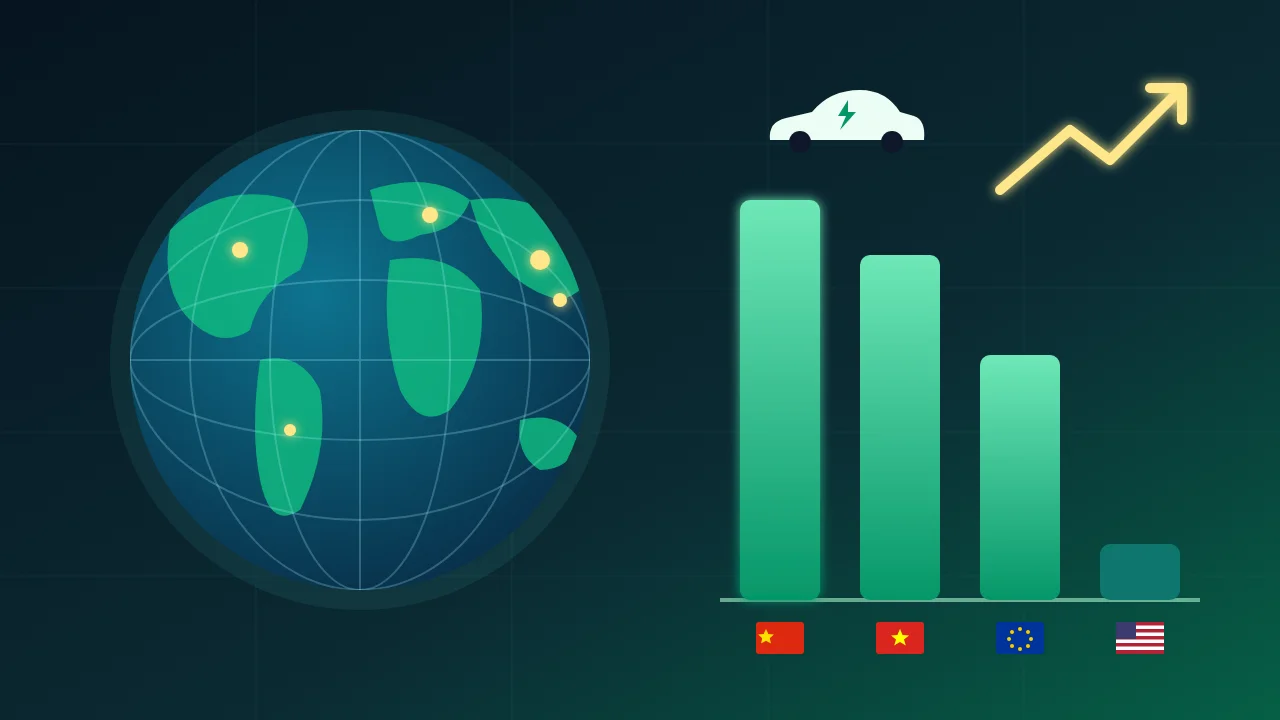
The electric car continues its rise, but at very different speeds depending on the region. According to the latest market monitor published on 27 October 2026 by the International Council on Clean Transportation (ICCT), more than 9.4 million electric vehicles were sold worldwide in the first half of 2026, almost one in four new light vehicles. Here is what the figures reveal.
Key figures for the first half of 2026
| Market | Share of electric vehicles in new sales (H1 2026) | Trend |
|---|---|---|
| World | Almost 25% | 9.4 million units sold |
| China | 51% | Up |
| Europe | 31% | Up from 27% in 2025 |
| United States | About 7% | Down 2 points from 2025 |
| India | 5% | Up 1 point (about 146,000 units) |
| Vietnam | 44% | Up from 37% in 2025 |
In these statistics, "electric vehicles" include fully electric cars (BEV) and plug-in hybrids (PHEV). Conventional hybrids, which cannot be plugged in, are not counted.
China: more than one in two new cars is electric
China remains by far the engine of the market. In the first half of 2026, electric vehicles accounted for 51% of new light vehicle sales there. Fully electric models are gaining ground over plug-in hybrids: they now represent 68% of electric sales, compared with 64% in 2025. China also produces around two thirds of the world's electric vehicles.
The case of BYD illustrates this dynamic. In October 2026, the world's leading electric vehicle manufacturer sold 490,168 new energy vehicles, including a record 305,743 fully electric cars, up 37% in one year. For the first time, BYD exceeded 300,000 battery electric cars in a single month. Its plug-in hybrid sales, on the other hand, fell by 17%. The group exported more than 170,000 vehicles in October alone and is targeting around two million vehicles sold abroad in 2026.
Europe: steady progress, led by fully electric cars
In Europe, 31% of new light vehicles sold in the first half of 2026 were electric, compared with 27% in 2025. Fully electric cars account for 69% of these sales, and almost all major manufacturers now sell more battery electric cars than plug-in hybrids. Competition is intensifying: Chinese brands are gaining market share, and around 65% of electric vehicles imported into Europe come from China, according to the ICCT.
The regulatory framework continues to evolve, with in particular the Euro 7 standard, which comes into force for new models at the end of November 2026 and introduces minimum battery durability requirements.
United States: the electric transition slows down
The contrast with the United States is striking. The share of electric vehicles in new sales fell to around 7% in the first half of 2026, two points lower than in 2025. Many traditional manufacturers have reduced their electric ambitions and are focusing on a wider mix of powertrains. To give an idea of scale: in October 2026, BYD alone sold more fully electric cars than the whole US market during the third quarter, estimated at just over 262,500 units by Kelley Blue Book.
Emerging markets: the surprise of the year
The fastest progress is now often seen in emerging markets. In the 11 emerging countries studied by the ICCT, the share of electric vehicles rose by 3 points in one year:
- Vietnam reaches 44% of electric vehicles in new sales, a higher share than Europe or the United States.
- Colombia almost doubled its share, from 11% to 19%.
- In the Philippines, electric vehicles accounted for 15% of sales in the first half of 2026, more than double the 2025 level, with BYD holding 68% of the electric market.
Affordable models from Chinese manufacturers, tax incentives and, in some countries, rising fuel prices explain this acceleration. But protectionist measures are also appearing: Thailand, for example, has just approved a sharp increase in taxes on imported electric vehicles to support local production.
What these figures mean for buyers
- More choice and lower prices: competition between manufacturers, especially Chinese ones, is driving down prices and accelerating the arrival of new models.
- Fully electric is taking over from plug-in hybrids in the most advanced markets, as ranges increase and charging networks expand.
- Charging infrastructure is becoming the decisive factor: where it is available, adoption accelerates quickly.
The global picture is clear: the electric car is no longer a niche product. With almost one in four new cars sold worldwide now electric, the question is no longer whether the transition will happen, but how fast each market will make it.